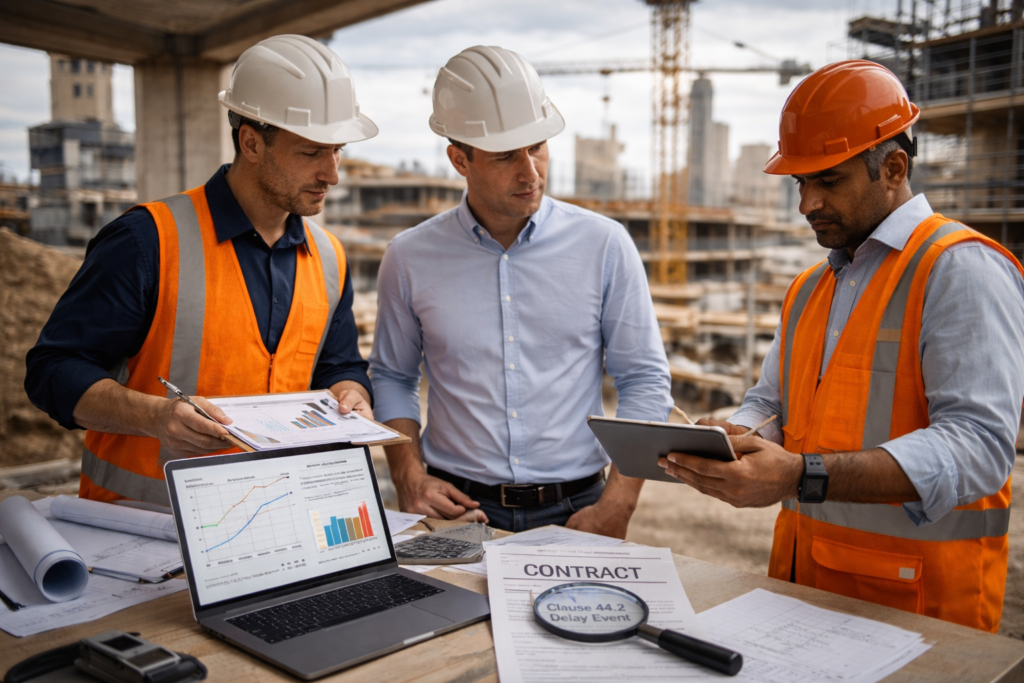
Construction claims rarely fail because there is no entitlement. They fail because the entitlement is not evidenced clearly, consistently, or in a way that aligns with the contract. In the UK market, most contracts already define the principles and route to recovery for time and cost. The challenge is translating what actually happened on site into defensible, quantifiable proof that satisfies those contractual tests.
AI for construction claims is increasingly being explored as a way to bridge that gap. Not by inventing entitlement, and not by bypassing professional judgement, but by working through large volumes of contemporaneous project data and aligning it back to the contract mechanisms that already exist. Used properly, it supports established methodologies such as Earned Value Analysis, Measured Mile, and cause-and-effect analysis rather than replacing them.
The reality on most projects is that information is fragmented. Programmes, cost reports, site records, instructions, and correspondence often sit in separate systems and are reviewed under time pressure, usually long after events have occurred. AI does not change the legal or contractual position, but it can materially change how quickly and accurately those records are analysed and connected.
In that sense, AI for construction claims is best understood as an evidence accelerator. It supports professionals by improving visibility, traceability, and consistency, allowing entitlement arguments to be grounded more firmly in data that already exists within the project record.
Where the construction claims process really slows down
Delay and disruption claims tend to stall at predictable points. These are not theoretical issues; they are practical frictions that most contractors, consultants, and adjudicators recognise immediately.
- Identifying which contractual clauses are actually engaged by the events that occurred
- Extracting relevant data from programmes, cost systems, and site records
- Demonstrating cause and effect between an event and a measurable impact
- Reconciling different versions of the programme over time
- Quantifying loss and expense in a way that aligns with the chosen methodology
Under NEC, JCT, or bespoke contracts, the principles of entitlement are usually clear. What consumes time is the manual effort required to map events to obligations, to show contemporaneous impact, and to present that analysis in a form that is intelligible to the other party. This is where AI for construction claims can provide meaningful assistance.
A.I. does not replace professionals — it improves what happens around them
There is understandable concern within the industry about any suggestion that AI might automate claims preparation or replace experienced commercial professionals. That concern is misplaced if AI is positioned correctly. Contracts are interpreted by people, not software. Entitlement relies on judgement, context, and professional responsibility.
What AI can do is improve the quality and completeness of the information that professionals work with. By rapidly processing large datasets, AI can highlight patterns, inconsistencies, and correlations that would otherwise take weeks to uncover manually. The decision-making, strategy, and accountability remain firmly with the practitioner.
Traditionally, the quantity surveyor:
- Reviews the contract to identify relevant clauses for time and cost recovery
- Manually extracts programme data to assess critical path impact
- Reconstructs progress and productivity from site records
- Applies methodologies such as Earned Value Analysis or Measured Mile
- Prepares narratives and schedules to demonstrate cause and effect
With AI-assisted support, this workflow does not disappear. Instead, the data-heavy elements are augmented. AI can ingest programmes, cost reports, and daily records simultaneously, flagging relevant periods, anomalies, and correlations. The professional still selects the methodology, interprets the findings, and frames the entitlement, but does so with a more complete and consistent evidence base.
Faster understanding leads to faster decisions
One of the most immediate benefits of AI for construction claims is speed of understanding. On complex projects, simply establishing what happened, when, and to what extent can take a disproportionate amount of time. AI can process historic and live data sets quickly, allowing teams to move to analysis rather than data gathering.
For example, in Earned Value Analysis, AI can automatically align planned value, earned value, and actual cost across reporting periods, highlighting variances that merit closer review. This does not remove the need to explain why those variances exist, but it ensures that discussions are grounded in consistent metrics rather than competing spreadsheets.
Similarly, when assessing disruption through Measured Mile analysis, AI can assist by identifying suitable baseline periods, validating productivity rates, and testing sensitivity across different timeframes. The methodology remains orthodox; the difference is that the preparatory work is faster and more transparent.
Reducing the clarification loop
Claims frequently become protracted because of repeated requests for clarification. Each request adds time, cost, and friction, often without materially advancing the underlying issue. This is usually a symptom of unclear linkage between the contract, the event, and the quantum.
AI can help reduce this loop by improving traceability. When assertions are directly linked to contemporaneous records and contractual clauses, it becomes easier for the receiving party to understand how a figure has been derived. That does not guarantee agreement, but it does narrow the scope of dispute.
By structuring evidence in a way that mirrors the contract’s route to entitlement, AI-supported analysis can make claims more navigable. This is particularly valuable in adjudication, where timeframes are compressed and clarity is critical.
Earlier awareness of issues
Another practical advantage of AI for construction claims is earlier visibility of potential entitlement. Rather than waiting until a claim is prepared retrospectively, AI can be used during delivery to monitor performance against programme and cost baselines.
This allows emerging delay or disruption to be identified closer to real time. Where contracts require timely notification or early warning, this can materially reduce the risk of losing entitlement through procedural non-compliance. Again, AI does not make the notification; it supports the professional by highlighting when contractual thresholds may have been crossed.
Earlier awareness also supports more informed commercial decision-making. Parties can address issues while options still exist, rather than debating liability after positions have hardened.
Better alignment between professionals
Claims often involve multiple disciplines: commercial managers, planners, engineers, and legal advisers. Misalignment between these roles can undermine otherwise valid entitlement. AI can act as a common analytical layer, ensuring that programme impact, cost consequences, and contractual analysis are based on the same underlying data.
This shared evidence base does not remove professional differences of opinion, but it reduces the risk that those differences arise from inconsistent information. In practice, that can lead to more focused discussions and a clearer articulation of each party’s position.
Tools such as SurvAI, when used carefully, are an example of how AI can support this alignment by structuring data and analysis without dictating conclusions.
Speed without cutting corners
It is important to be explicit about what AI for construction claims does not do. It does not determine entitlement. It does not override the contract. It does not replace professional judgement, nor does it remove the need for careful explanation of cause and effect.
What it does is reduce the time spent on mechanical tasks such as data collation, cross-referencing, and reconciliation. That time saving can then be reinvested in higher-value activities: testing assumptions, stress-testing methodologies, and ensuring that the claim narrative is balanced and credible.
Speed achieved through better information flow is fundamentally different from speed achieved by cutting corners. The former strengthens claims; the latter weakens them.
The future of AI for construction claims in England
The future of AI for construction claims in England is likely to be evolutionary rather than disruptive. Established methodologies such as Earned Value Analysis and Measured Mile are not going away. Nor are the contractual frameworks that govern entitlement.
What is changing is the expectation around evidence quality. As AI-assisted analysis becomes more common, poorly evidenced claims may stand out more starkly. Conversely, well-structured, data-led submissions may become easier to evaluate and resolve.
For professionals, the opportunity lies in using AI as a support tool while maintaining clear accountability for judgement and advice. For clients, the benefit is improved transparency around how time and cost recovery has been assessed.
Ultimately, AI for construction claims is not about winning more disputes. It is about presenting entitlement in a way that is clearer, more consistent, and more closely aligned with the contract. Used responsibly, it can help move the industry towards earlier resolution and fewer surprises, without undermining the professional rigour on which the process depends.
In summary, AI can provide detailed, quantifiable evidence by analysing project data through the lens of the contract and established methodologies. It supports, rather than replaces, professional judgement, helping contractors demonstrate entitlement to time and cost recovery more clearly and efficiently. The core principles remain unchanged; the route to evidencing them becomes more robust.